


 English
  русский
  عربى
عربى  Español
What are the main categories of pipe fittings used in industrial piping systems?
Content
- 1 The Five Categories of Pipe Fittings Every Industrial System Relies On
- 2 Directional Fittings: Changing the Path of Flow
- 3 Branching Fittings: Splitting and Combining Flow Paths
- 4 Transitional Fittings: Adjusting Pipe Diameter
- 5 Terminating Fittings: Sealing the Ends of a System
- 6 Connecting Fittings: Joining Pipe Sections Together
- 7 Material Selection: Why Metal Pipe Fittings Dominate Industrial Applications
- 8 Matching Fitting Categories to System Requirements
- 9 Common Sizing and Standards Considerations
- 10 Final Takeaway
Piping Systems Guide
The Five Categories of Pipe Fittings Every Industrial System Relies On
From redirecting flow to sealing an open end — how directional, branching, transitional, terminating, and connecting fittings work together inside a piping network.
Pipe fittings used in industrial piping systems can be grouped into five main functional categories: directional fittings (elbows and bends), branching fittings (tees, crosses, and laterals), transitional fittings (reducers and adapters), terminating fittings (caps and plugs), and connecting fittings (couplings, unions, and flanges). Each category serves a distinct mechanical purpose within a piping network: directional fittings change the flow path, branching fittings split or combine flow, transitional fittings adjust pipe diameter, terminating fittings seal off open ends, and connecting fittings join pipe sections together — either permanently or with the option for future disassembly. Metal pipe fittings, particularly stainless steel tube fittings, dominate industrial applications because they combine mechanical strength with corrosion resistance across a wide range of pressures, temperatures, and chemical exposures.
Understanding these five categories — and which specific fitting type within each suits a given application — is the foundation for a piping system that performs reliably from installation through decades of service.
Directional Fittings: Changing the Path of Flow
Directional fittings redirect the flow of fluid or gas around obstacles, corners, or equipment. The most common type is the elbow, available in 45-degree and 90-degree configurations, which allows a pipe run to change direction without the sharp turbulence that a mitered joint would create. Elbows are further divided into long-radius and short-radius designs: long-radius elbows have a bend radius roughly 1.5 times the pipe diameter, producing a gentler curve that reduces pressure drop, while short-radius elbows have a bend radius equal to the pipe diameter, making them more compact but slightly more restrictive to flow.
Bends vs. Elbows
While elbows are typically shorter, prefabricated components, pipe bends are formed from a continuous length of pipe using a bending machine. Bends generally offer a smoother internal flow path with less turbulence than elbows, which makes them a common choice in high-flow-rate systems such as power plant piping or large water transmission lines. In smaller-diameter systems, particularly those built with stainless steel tube fittings, compact elbows remain the more practical and cost-effective option due to easier fabrication and installation.
Branching Fittings: Splitting and Combining Flow Paths
Branching fittings allow a single pipe run to split into multiple paths or combine multiple paths into one. The most widely used branching fitting is the tee, which creates a 90-degree branch off a main line. Tees come in two configurations: equal (or straight) tees, where all three openings share the same diameter, and reducing tees, where the branch opening is smaller than the main run. Crosses extend this concept further by adding a fourth opening, allowing flow to split in two directions simultaneously — though crosses are less structurally robust than tees and are generally avoided in high-pressure applications due to the added stress concentration at the junction point.
Info
Lateral (wye) fittings branch off the main line at 45 degrees rather than 90. This shallower angle reduces turbulence and pressure loss, making laterals a preferred choice in gravity drainage and chemical processing lines.
Choosing a lateral over a standard tee can meaningfully reduce head loss in long piping runs, particularly in systems moving large volumes of liquid at moderate velocities.
Transitional Fittings: Adjusting Pipe Diameter
Transitional fittings, most commonly reducers, allow a piping system to change diameter along its length — for example, stepping down from a 6-inch main line to a 4-inch branch feeding a piece of equipment. Reducers come in two forms: concentric reducers, which taper symmetrically around a shared centerline, and eccentric reducers, which keep one edge flat while tapering the other.
| Reducer Type | Alignment | Best Use Case |
|---|---|---|
| Concentric | Centered on shared axis | Vertical piping runs |
| Eccentric (flat up) | Offset, flat top | Preventing air pockets in liquid lines |
| Eccentric (flat down) | Offset, flat bottom | Ensuring full pipe drainage |
Beyond reducers, adapters serve a related but distinct purpose: converting between different fitting standards or thread types, such as transitioning from a threaded connection to a socket weld end. Adapters are especially useful when integrating equipment manufactured to different regional standards into a single piping system.
Terminating Fittings: Sealing the Ends of a System
Terminating fittings close off open pipe ends, either permanently or in a way that allows future access. Caps are typically welded or threaded onto the very end of a pipe run and are used when no further extension of the line is planned. Plugs serve a similar purpose but are inserted into the female end of a fitting rather than fitted over the outside of a pipe, making them common at unused branch openings on tees or crosses.
Blind Flanges for Serviceable Termination
In larger-diameter systems, blind flanges are the preferred terminating fitting because they bolt onto a mating flange and can be removed later if the line needs to be extended or accessed for cleaning. This makes blind flanges a practical choice in process piping where future modifications are likely, even though they cost more upfront than a simple welded cap.
Connecting Fittings: Joining Pipe Sections Together
Connecting fittings join two lengths of pipe in a straight run without changing direction, diameter, or flow path. The three primary types are couplings, unions, and flanges, each offering a different balance of permanence and serviceability.
- Couplings create a fixed, generally non-serviceable joint, often welded or threaded, used where the connection is not expected to be disassembled
- Unions allow a joint to be opened and reconnected using hand tools, without cutting the pipe, making them ideal for equipment that requires periodic removal
- Flanges bolt two pipe ends together with a gasket in between, offering the highest degree of serviceability for large-diameter or high-pressure connections
Half-couplings, which have one threaded or welded end and one solid end, are also common for creating branch connections directly on a pipe wall without the strength penalty of drilling and threading the pipe itself.
Material Selection: Why Metal Pipe Fittings Dominate Industrial Applications
While plastic and composite fittings serve certain low-pressure or corrosive-chemical niches, metal pipe fittings remain the standard across most industrial piping systems due to their combination of mechanical strength, temperature tolerance, and long service life. Carbon steel fittings are common in general utility and structural applications where cost efficiency matters more than corrosion resistance. Stainless steel fittings, by contrast, are specified wherever corrosion resistance, hygiene, or high-temperature performance is required — food and beverage processing, pharmaceutical manufacturing, chemical plants, and marine environments among them.
metal pipe fittings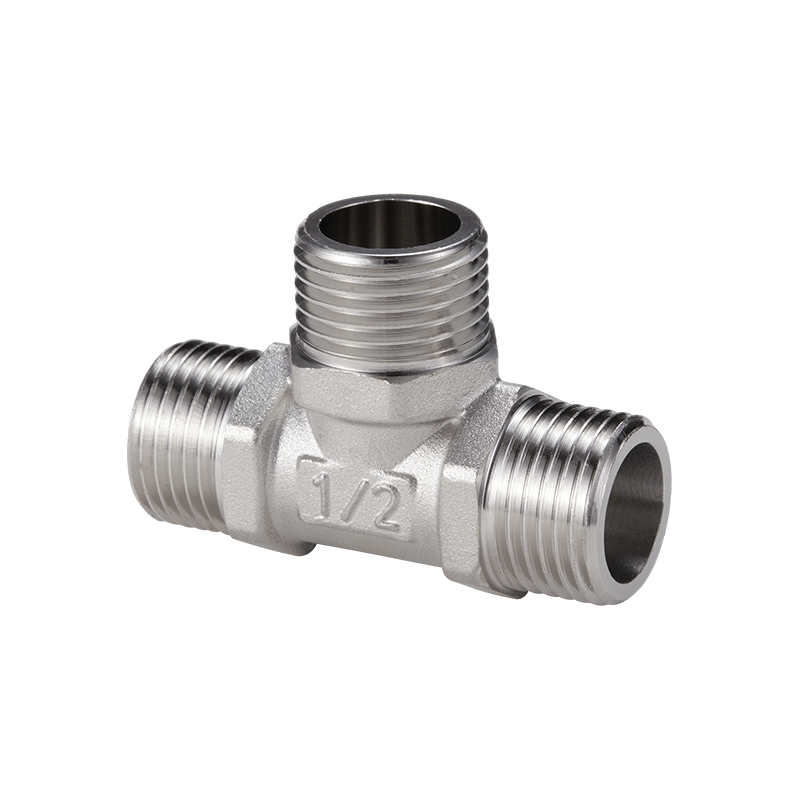
Where Stainless Steel Tube Fittings Fit In
Stainless steel tube fittings are typically used on smaller-diameter tubing runs — instrumentation lines, sample loops, and pneumatic control systems — where precision, cleanliness, and resistance to corrosion are critical. Unlike standard pipe fittings, tube fittings often rely on compression or flare-type connections rather than threads or welds, allowing for quick assembly and disassembly without specialized tools.
Practical Benefit
Compression and flare-type tube fittings make instrumentation and control systems easy to reconfigure — a real advantage in laboratory, semiconductor, and process-control environments that change frequently.
Matching Fitting Categories to System Requirements
Specifying the right combination of fitting categories starts with mapping out the physical requirements of the piping run: where direction changes are needed, where branches must split off, where diameters transition, where the line terminates, and where sections must be joined. A typical industrial process line might use long-radius elbows to minimize pressure drop around equipment, reducing tees to feed smaller branch lines, eccentric reducers to prevent trapped liquid at pump suction points, and flanged connections at every piece of rotating equipment for maintenance access.
- Map the full flow path, noting every direction change, branch, and diameter transition
- Identify points requiring future disassembly for maintenance, filtration, or equipment swaps
- Select fitting materials based on pressure, temperature, and chemical exposure at each point
- Confirm fitting standards (such as ASME B16.9 for butt weld fittings) match the piping specification
- Verify that connection types at equipment interfaces allow adequate clearance for service access
Warning
A common design error is specifying a fixed coupling at a point that will later need disassembly, or using a standard tee where a lateral would significantly reduce turbulence and energy loss.
Common Sizing and Standards Considerations
Industrial pipe fittings are manufactured to standardized dimensional and pressure specifications to ensure compatibility across manufacturers and easier system design. In North America, ASME B16.9 governs factory-made wrought butt weld fittings, while ASME B16.11 covers socket weld and threaded forged fittings. Internationally, standards such as EN 10253 serve a similar role in European markets.
Danger
Matching the fitting's pressure class and wall thickness schedule to the connecting pipe is essential, since a mismatch can create a weak point in the system even if the individual components meet their own specifications. Schedule 40 and Schedule 80 are the most common designations, with higher schedules reserved for elevated-pressure service.
Final Takeaway
Industrial pipe fittings organize into five functional categories — directional, branching, transitional, terminating, and connecting — each addressing a specific structural or flow requirement within a piping system. Directional fittings like elbows and bends redirect flow, branching fittings like tees and laterals split or merge lines, transitional fittings like reducers adjust diameter, terminating fittings like caps and blind flanges close off ends, and connecting fittings like couplings, unions, and flanges join sections together with varying degrees of serviceability. Across nearly all of these categories, metal pipe fittings remain the dominant material choice for their strength and durability, while stainless steel tube fittings serve a specialized role in smaller-diameter, high-precision instrumentation and control applications. Understanding how these categories work together allows engineers and buyers to design piping systems that balance flow efficiency, maintainability, and long-term reliability.
Related News
Contact Us
-

-
 +86-0574-63742169
 -
 No.104-128, Cizhang East Road, Zhangqi Town, Cixi City, Ningbo, Zhejiang Province, China


Message Us Now !
