Picture a service engineer with a hundred half-inch brass ball valves, a manifold drilled and tapped, and a handle that stops at sixty degrees because the neighbouring pipe is in the way. Nothing is broken. The valve was specified by thread size alone, and thread size says nothing about handle sweep, bore, or how the part behaves once it is installed.
The practical answer for a 1/2 inch compact ball valve: match the thread to the mating fitting, choose full or standard port according to what the line feeds, confirm the handle completes a clean quarter turn in the space available, and hold the body to a 16 bar WOG rating with PTFE seats. The sections below explain why each of those four points matters more than the price per piece.
What Compact and Half Inch Actually Specify
Two words carry most of the specification. Half inch describes the connecting thread, not the waterway inside. Compact describes the external envelope: the length of the body and the sweep of the handle. Treating them as one attribute is how buyers end up with a valve that threads in perfectly and still performs badly.
The internal bore is what shapes flow. In a half-inch body, a standard-port ball leaves a waterway of roughly 8 to 10 mm, while a full-port ball opens to about 11 to 12 mm. On a short branch that difference is invisible. On a long run, a heater coil, or a gas appliance, it appears as pressure drop that the pump or the regulator has to absorb.
Typical values for a 1/2 inch compact brass ball valve and the question each one answers in the field.
Parameter
Typical value at 1/2 inch
What it decides
Nominal size
DN15 / 1/2 inch
Thread match: BSP and NPT are not interchangeable
Port
Standard port approx. 8 to 10 mm; full port approx. 11 to 12 mm
Flow capacity and pressure drop
Body length
Approx. 40 to 55 mm
Manifold spacing and fit inside a recess
Handle sweep
Butterfly approx. 40 mm; lever approx. 70 to 95 mm
Clearance from walls, pipes and neighbouring valves
Pressure rating
16 bar / 232 psi WOG, non-shock
Margin against surge and water hammer
Temperature range
Approx. -10 to +120 degrees C with PTFE seats
Seat and seal material selection
Read the table as a set of field questions: will it thread, will it pass enough flow, will it fit the recess, will the handle turn, and will it hold when the pump stops.
Where Compact Bodies Earn Their Place
Compact valve patterns exist because installation space is finite, and the constraint is almost never pressure.
Manifold and distribution banks: several half-inch valves sit shoulder to shoulder, so every millimetre of body length and handle sweep counts.
Appliance and boiler cabinets: a long lever can foul the housing or block service access, while a butterfly or mini handle opens inside the valve footprint.
Small equipment and panel assemblies: water treatment, compressed air and laboratory lines need a valve that matches the scale of the tubing around it.
A valve that cannot be fully exercised is treated as a half-working shut-off, and operators compensate by forcing the handle or leaving the line permanently open. Both habits shorten the life of the seats.
The Standard Baseline: Long Lever, Standard or Full Port
Not every half-inch line needs a compact pattern. Where there is clearance, a long-handle ball valve is easier to operate with gloves, shows its position at a glance, and gives more leverage on a seat that has been closed for months.
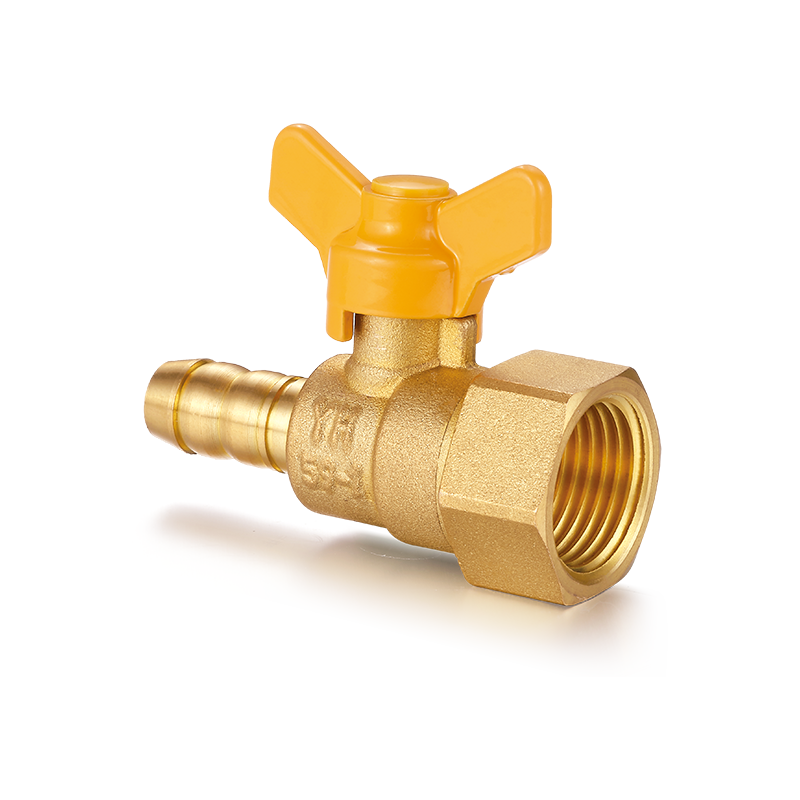
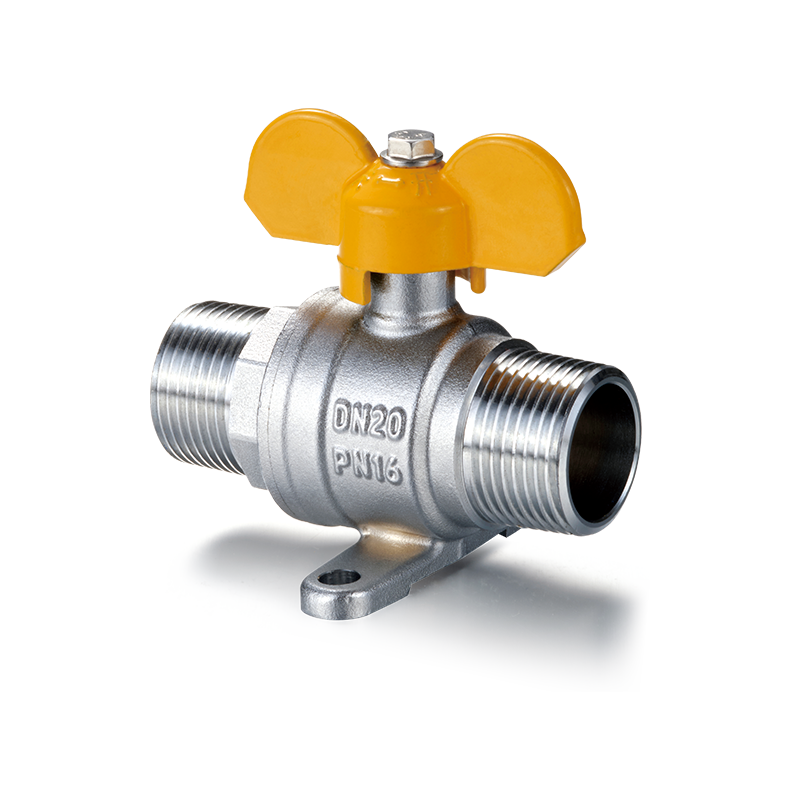
Thread-end combinations deserve the same attention as the handle. Female-female bodies suit spigot and manifold connections. Female-male and male-male patterns remove an adapter from the assembly and, with it, a potential leak path, which is why matching the combination to the pipework already on site keeps both inventory and installation simpler.
Handle choice decides whether the valve can be operated at all, and in most projects it is settled last.
Lever handle: roughly 70 to 95 mm of sweep on a half-inch body, the best mechanical advantage, and the easiest position to read from a distance.
Butterfly or wing handle: around 40 mm, opening within the valve footprint, which suits manifold banks and appliance cabinets.
Mini handle: the shortest option, matched to mini valve bodies, convenient where the valve is set once and rarely adjusted.
A handle that cannot finish its quarter turn turns a precision valve into a plug. It costs almost nothing to design out and a full batch to correct.
Lockability is a separate decision. Magnetic and mechanical lockable patterns restrict operation to authorised staff, which matters on shared risers, outdoor taps and gas laterals.
Body, Seats and the Temperature You Forgot
Brass is a family of alloys rather than a single metal. Bodies intended for potable water and long service in damp conditions are typically specified in dezincification-resistant grades such as CW617N or HPb58-3, and the difference shows up as stress-corrosion cracking years later rather than in a pressure test on delivery day.
Seats and seals set the working temperature. PTFE seats with EPDM O-rings cover most cold and warm water duty, with catalogue limits commonly around -10 to +120 degrees C. Above that range the seat material, not the brass, becomes the constraint, and the application should be reviewed before the valve is selected.
Pressure needs the same caution. The 16 bar figure on a compact half-inch valve is a non-shock rating. Water hammer from a fast-closing solenoid upstream can spike well above line pressure, so the margin should be sized for transients rather than for a steady gauge reading.
Matching the Valve to Water, Gas and Hose Service
Application decides the last details. On cold and warm water lines, a standard-port valve with a lever handle is usually the most economical choice, and full port is reserved for equipment sensitive to pressure loss.
On gas laterals, the priorities shift towards sealing and control of access. Compact bodies fitted with lockable handles reduce unauthorised operation, and the seat material should be confirmed for the gas in question rather than assumed from the water duty.
Where a valve connects directly to flexible tubing, hose-connector patterns save an extra fitting, and where abnormal flow is a genuine risk, an excess-flow shutoff version closes automatically instead of discharging freely.
Quality Control Before You Approve a Batch
For valves bought in quantity, batch consistency matters more than the single sample placed on the table. A practical incoming inspection covers thread fit with a gauge at both ends, freedom of ball rotation under pressure, seat tightness tested above the rated pressure, plating adhesion on the body, and the torque required to open a valve that has been closed for some time.
Ask how those checks are recorded. A supplier working under a documented quality management system can show inspection records per batch, which is what makes a repeat order predictable rather than hopeful.
Ordering Checklist for a Half Inch Compact Valve
Confirm the mating thread, BSP or NPT, male or female, and the end combination you need.
Decide the port: standard for cost and compactness, full port where pressure drop matters.
Measure the available handle sweep before choosing the lever pattern.
Match seat and seal material to fluid temperature and any chemical exposure.
Set the rating against surge conditions, not only against static line pressure.
Agree the inspection routine and the records that should accompany each batch.
None of these decisions is complicated on its own. Together they explain why two half-inch brass ball valves that look identical on a bench can behave very differently after a year in service. Fix the thread, the port, the handle sweep and the rating before the order is placed, and the valve disappears into the system, which is exactly what a well-specified component should do.
1/2 in. ID Tubing, Barbed Brass Ball Valve: Getting the Fit Right the First Time
A practical guide to barb sizing, port bore, brass grade and clamp practice for hose-fed water, gas and fluid lines.
A 1/2 in. I...
The 1/2 Brass Ball Valve Block and Bleed Setup, Explained for Buyers and Installers
Two ordinary brass ball valves and one small bleed point can deliver what an expensive engineered valve is often bought for:...
1/2 FNPT x MNPT Brass Ball Valve Inline: The Practical Selection Guide
A straight-through brass ball valve with a 1/2-inch female NPT inlet and male NPT outlet solves a specific piping problem. The details de...
1/2 Inch 12VDC Brass Ball Valve: Getting the Body and the Actuator to Agree
Size, voltage and material look like a complete specification. They are not. Here are the decisions still open on the purchase order,...
Brass Valve Selection Guide
1/2 NPT Brass Ball Valve Inline: Sizing, Threads, and Buying Guide
A practical reference for engineers and buyers specifying one of the most common brass valves in water and gas se...
Component Selection · Fluid Control
Small Valve. Serious Selection.
A brass mini ball valve often sits in the tightest corner of a system, yet it carries the same responsibility as valves many times its size....



 English
  русский
  عربى
عربى  Español
 View More
 View More
 View More
 View More
 View More
 View More

 +86-0574-63742169
 No.104-128, Cizhang East Road, Zhangqi Town, Cixi City, Ningbo, Zhejiang Province, China

