1/2 in. Compression Full Port Brass Ball Valve: How to Specify One That Never Leaks
Bore size, ferrule joints, alloy certification, and the details that decide whether a quarter-turn shutoff survives its first winter.
The shutoff valve under a kitchen sink fails on a Friday evening. The copper stub is two inches long, the cabinet is tight, and nobody wants a torch inside a finished wall. That is the job a 1/2 in. compression full port brass ball valve was built for: it seals on the outside of the tube with a brass ferrule, gives quarter-turn isolation, and needs no flame, flux, or solder.
Conclusion first: for most 1/2 in. copper isolation points, this valve is the right default. Full port keeps pressure loss low, compression keeps the joint serviceable, and brass keeps the cost sensible. When these valves fail, the ball is rarely the reason. They fail because the tube outside diameter was wrong, a ferrule was reused, or an unapproved alloy went onto a drinking water line.
What follows is the specification in the order it deserves to be checked: dimensions, port style, connection ends, materials, installation, and the paperwork a buyer should demand.
What 1/2 in., Compression, and Full Port Actually Mean
The keyword is often typed as 1 2 compression full port brass ball valve, but each word is a separate commitment you will have to live with after the wall is closed.
- 1/2 in. is a nominal size, not a measurement. On copper tubing it means 5/8 in. outside diameter (15.88 mm). On NPT threads it describes a thread about 0.84 in. across the outside. On European metric tube, the nearest equivalent is 15 mm.
- Compression means the valve carries a nut and a brass ferrule that is crushed onto the tube OD. It is a mechanical seal: no heat, no flux, and it can be reopened.
- Full port means the ball bore is close to the tube bore, roughly 0.50 in. (12.7 mm) inside a 1/2 in. body, so the valve adds almost no restriction.
- Brass is usually a hot-forged copper-zinc alloy; drinking water service requires a lead-free grade.
- Ball valve means quarter-turn isolation. It is not a throttling device, and using it as one wears the seats.
Full Port and Standard Port Are Different Valves
A standard port 1/2 in. ball valve typically has a bore near 0.37 to 0.40 in., a little over half the flow area of a full port body. In a short, well-pressurised run that gap is easy to ignore. In gravity-fed lines, long runs, low-pressure gas, and anything feeding a tankless heater, it shows up as slow fill times, noisy flow, and equipment faults.
Typical port data for 1/2 in. brass ball valves. Values vary by manufacturer, so confirm the bore in writing before ordering.
| Port type |
Ball bore |
Relative flow area |
Typical Cv |
Best suited to |
| Full port |
about 0.50 in. (12.7 mm) |
100 percent |
9 to 10 |
Gravity lines, low-pressure gas, tankless heaters, long runs |
| Standard port |
about 0.37 to 0.40 in. |
roughly 55 to 60 percent |
5 to 6 |
Short isolation points with stable pressure |
| Compact or mini |
about 0.31 in. or less |
under 40 percent |
3 to 4 |
Tight cabinets and small appliance feeds |
Bore size is the one specification you cannot fix after the wall is closed. Everything else is a wrench away.
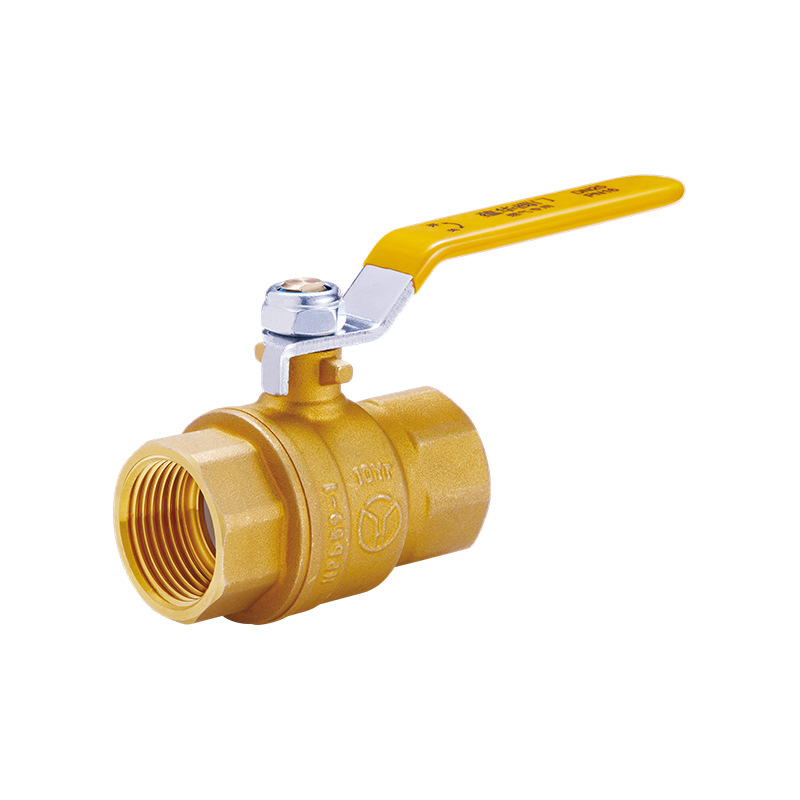
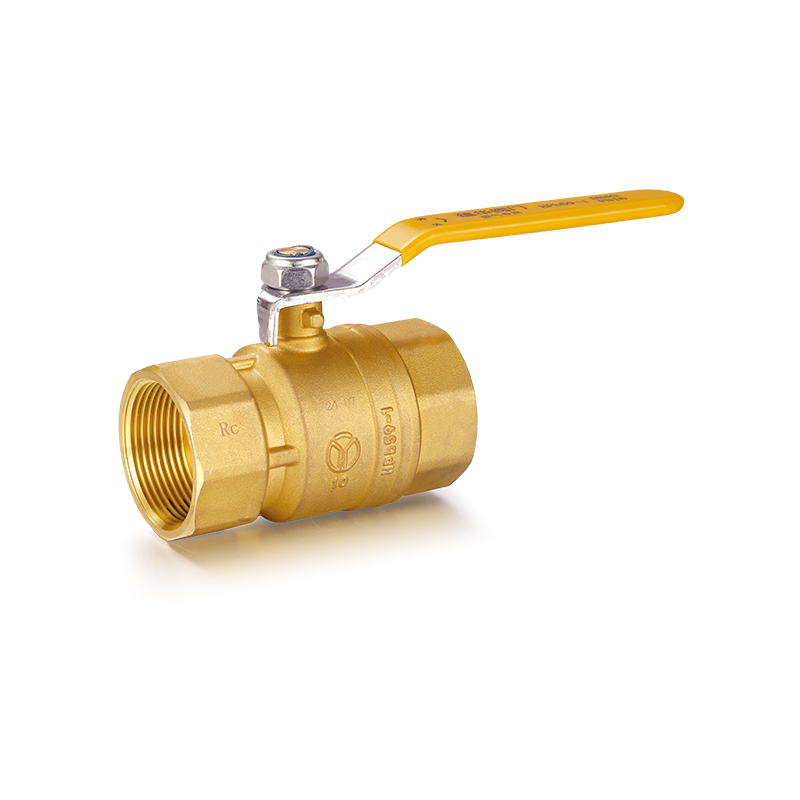
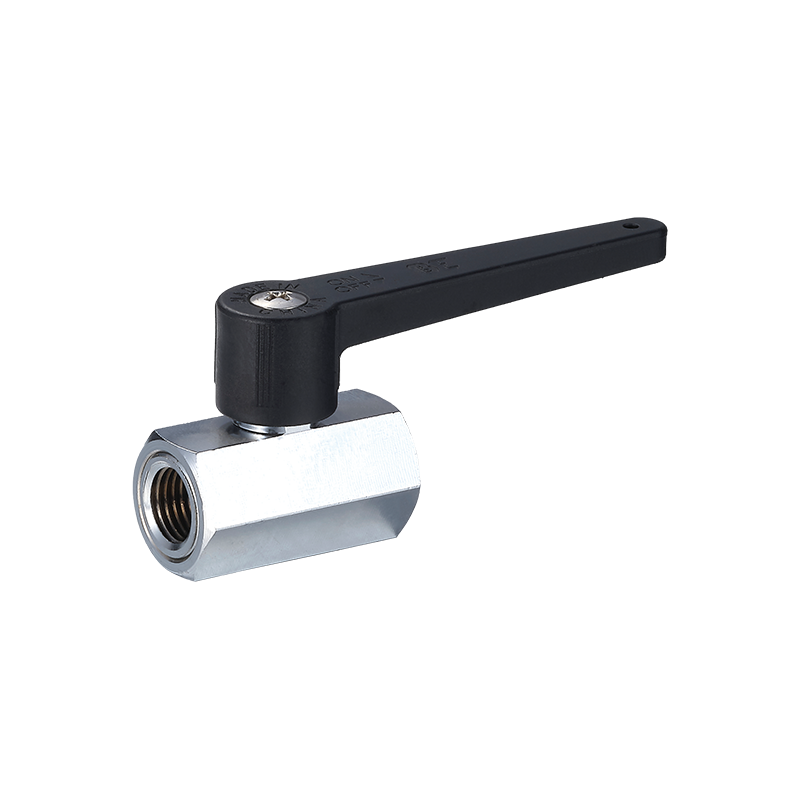
Full port also matters when the valve sits permanently in the flow path rather than acting as an occasional isolation point. A full port long handle brass ball valve keeps the line's effective bore intact through years of daily operation, which is why specifying by port rather than by price is usually the cheaper decision.
Compression Ends Against Threaded, Push-to-Connect, and Flare
The connection end is chosen by the pipe you already have, the code you must satisfy, and how much space the cabinet allows.
- Compression: seals on the tube OD, tolerates slight misalignment, and can be reopened. It needs the exact tube size and a square cut.
- Threaded (NPT or ISO 228): seals on the threads with tape or paste. Strong and gas-ready, but it needs clean threads and a back-up wrench.
- Push-to-connect: fastest to install, though the seal depends on an O-ring that ages. Sensible in accessible spots, risky inside a closed wall.
- Flare: required by many gas codes for tubing connections, and the safer choice wherever a compression joint is not permitted.
InfoMeasure the tube with a caliper before ordering. 5/8 in. (15.88 mm) and 15 mm tubing look identical in a photograph and will not interchange on the same nut and ferrule.
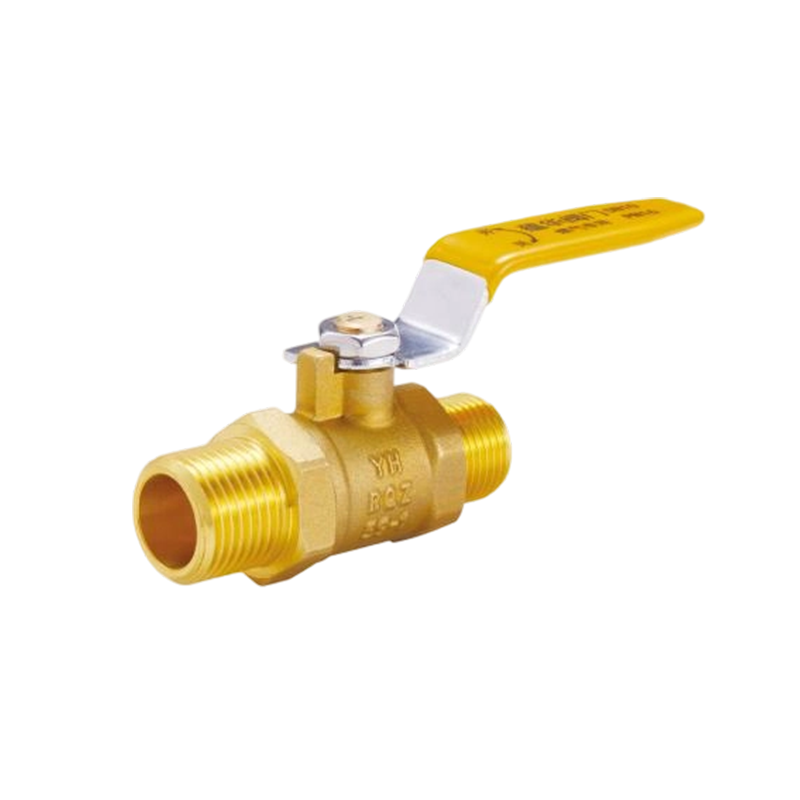
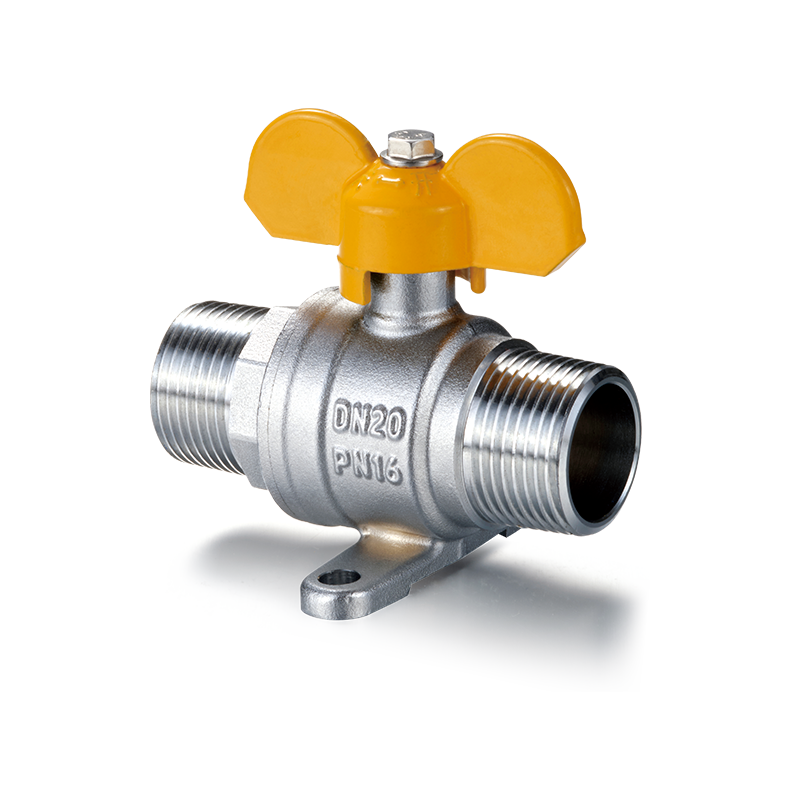
When one end must land on an existing threaded stub and the other on a new fitting, a valve with mixed port ends keeps the assembly short. A female-male 1/2 in. ball valve with a long handle is the usual answer there, and it avoids stacking an extra nipple and coupling inside a tight cabinet.
Alloys, Seals, and Ratings That Decide Service Life
- Body: hot-forged brass, commonly CW617N. Potable water calls for a lead-free grade such as CW510L, C27450, or C69300.
- Ball: chrome-plated brass, polished. Plating pits are where weeping starts, so ask about the finish, not only the material.
- Seats and stem seals: PTFE, normally rated from about -4 °F to 250 °F (-20 °C to 121 °C).
- Stem: a blowout-proof design with double O-rings is standard on decent valves and missing on cheap ones.
- Pressure: read two numbers. 600 psi WOG (water, oil, gas, non-shock) is not the same as 150 psi WSP (steam working pressure), and neither is a continuous rating at 250 °F.
- Standards: MSS SP-110 covers the valve itself, NSF/ANSI 61 and 372 cover lead-free potable water, and ANSI Z21.15 or CSA 9.1 covers gas appliance valves.
DangerNo lead-free certification mark means no potable water installation. NSF/ANSI 372 limits weighted average lead content to 0.25 percent, and a supplier that cannot produce the certificate should not be assumed to comply.
Where These Joints Start Dripping: Five Causes
- The tube was not cut square, or the burr was left in place, so the ferrule could not bite evenly around the circumference.
- A ferrule or nut was reused after the joint had been opened. The crush is spent the first time, and a reused ferrule may hold for a week before it weeps.
- The compression nut was over-tightened. Roughly a quarter to a half turn past finger-tight is normally enough; more splits the ferrule or deforms the tube.
- The body was turned with a single wrench, twisting one joint while tightening the other. Always hold the valve body with a back-up wrench.
- PTFE tape was wrapped on the compression nut. Tape belongs on NPT threads only; on a ferrule joint it shifts the nut position and does nothing for the seal.
WarningCompression joints are not automatically acceptable on gas piping. Many jurisdictions require flare or threaded connections with an approved gas valve. Test every gas joint with soap solution or an electronic detector, never a flame, and leave the valve fully open or fully closed rather than half open.
The Procurement Checklist for Importers and Specifiers
A quarter-turn valve is a commodity purchase only until the first field failure. Before the purchase order is signed, ask for the following.
- A dimensional drawing with overall length, hex size, thread standard (NPT, ISO 228, or DIN 2999), and the tube outside diameter the compression end accepts.
- An alloy certificate and, for potable service, a lead-free test report.
- The leak test method and pressure, for example air under water at the rated pressure, applied to 100 percent of production.
- Handle cycle and torque data, plus ball surface finish and plating thickness.
- Weight per piece and body wall thickness, both reliable indicators of material substitution.
- Marking, packaging, batch traceability, sample lead time, and minimum order quantity.
Quoting the entire long handle brass ball valve range on one comparison sheet keeps port style, handle type, and end connections measured on the same basis instead of item by item.
SuccessApprove a sealed golden sample, keep one copy at incoming inspection, and require third-party reports from a recognised laboratory for each new production batch. Two documents and one physical sample remove most of the risk from this purchase.
Applications Where Full Port Pays for Itself
- Under-sink and toilet shutoffs, where a closed cabinet leaves no room for a torch.
- Water heater inlets and drain points, where full flow matters during flushing.
- Refrigerator and ice maker feeds, where small-bore restrictions cause repeated service calls.
- Irrigation zone heads and hose bibs, where low pressure makes every restriction expensive.
- Compressed air drops and approved gas appliance connections, where downstream equipment is sensitive to flow.
Where tampering is the greater risk, in multi-tenant buildings or public washrooms, a lockable handle version delivers the same quarter-turn operation with a restricted hand. Rising investment in urban water supply and gas infrastructure keeps pushing the quality floor for domestic valves upward, and buyers tend to follow the same direction in their own specifications.
The Short Version
Buy full port. Match the tube outside diameter with a caliper rather than an eye. Insist on a lead-free alloy and a certificate when the valve touches drinking water. Install once, with a new ferrule, a square cut, and a back-up wrench, then test the joint before the wall goes back up.
The valve itself costs very little; the failure costs a weekend. Specify the bore, the ends, and the paperwork, and the quarter turn will keep working long after everyone has forgotten who installed it.



 English
  русский
  عربى
عربى  Español
 View More
 View More
 View More
 View More
 View More
 View More

 +86-0574-63742169
 No.104-128, Cizhang East Road, Zhangqi Town, Cixi City, Ningbo, Zhejiang Province, China

